
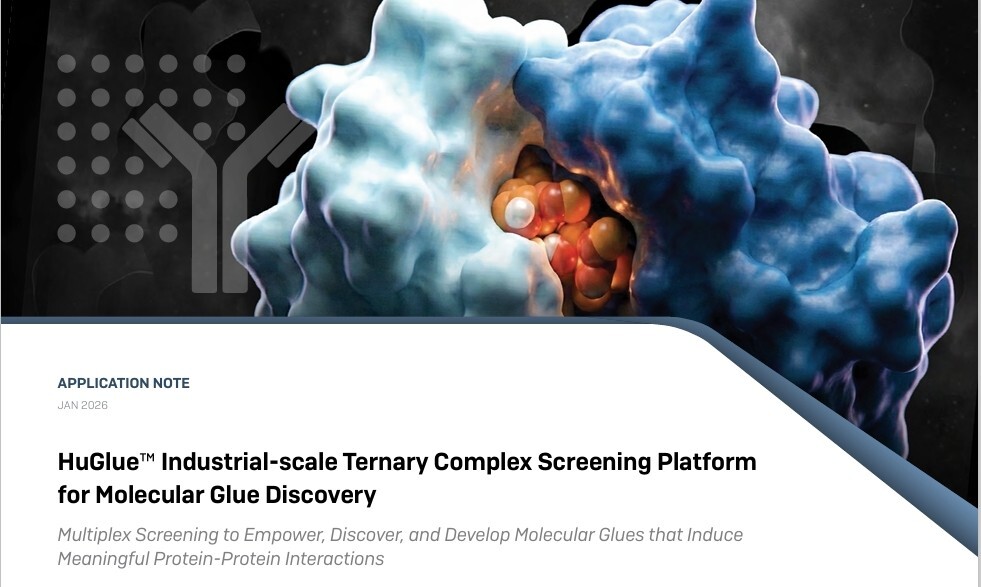
Rational Design Discovery of Molecular Glue Ternary Complexes

HuGlueTM eliminates serendipity, replacing it with rational design for molecular glue hit compound discovery. A multiplex platform for high-throughput screening of tripartite complexes.

The cost of a limited ecosystem in molecular glue pipeline discovery

Molecular glue ternary complexes underpin many next-generation therapeutic strategies, yet their discovery remains inefficient and unpredictable. Traditional approaches rely heavily on one-to-one screening, relying on serendipity from biochemical assays or offering limited insight from cell-based assays as to whether the biological impact is caused by the complex or by other cellular pathways being triggered.

MG app note for landing page

In the field today, much of the work focuses on these one-to-one interactions, limiting discovery by:

  • Missing the opportunity for comprehensive (all-to all) discovery - only looking under that lamp post

  • Limiting the flexibility and breadth of molecular glue modalities explored

  • Introducing ligase bias into discovery

These lead to the potential miss of the better molecular glue ternary complex, longer development timelines than necessary and increased risk of late stage failures
Read the case study

What is a Molecular Glue and Ternary Complex?

Understanding the mechanism behind targeted protein degradation and stabilization
 
Molecular glues are small molecules that bind simultaneously to two proteins (Target protein (A) and Presenter protein (B)), physically bridging them to form a stable tripartite complex. This ternary complex (Protein A—Glue—Protein B) can induce targeted protein degradation, stabilization, or disruption of protein-protein interactions. A major step forward in discovery comes from the innovation of a scalable biochemical screen for actual ternary complex formation, not just predicted interactions. This leads to molecular glue programs where there is:

Design and development of a rational molecular glue workflow

Flexible and rapid simultaneous screening for diverse Molecular Glue modalities

Agnostic discovery through evaluation of 100s to 1000s of PPIs in a single well

Reduced risk, accelerated milestones and expertise to support the goal

Improve downstream success rates

Multiplexed biochemical screening where a single well tests one drug against hundreds of protein-protein interactions, enabling millions of potential ternary complexes to be screened and rapidly identified

Accelerate speed of discovery

Screen any combination of proteins with individual compounds in a single well, across the human proteome. Access rapid assessment across all compound libraries, replacing serendipity with rational design

High-throughput capacity

Explore libraries of >200,000 compounds for direct detection of compound-induced ternary complex formation. Expand discovery beyond in-house libraries

Supports multiple modalities

Ability to screen degraders, binders, stabilizers, repellents and disruptors alongside different combination of ternary complex elements

Integrated cellular validation and biological testing

All-to-all biochemical screening finds the hit compounds to take into cellular validation. Cellular validation is integrated into the program, removing the bottleneck between biochemical discovery and proof of concept in biological relevance

Immediate access to an expert team

Focus on the outcome with hit compound discovery rather than building an specialist team. Partner with the right expertise to accelerate novel discoveries to drug the undruggable

HuGlue case study

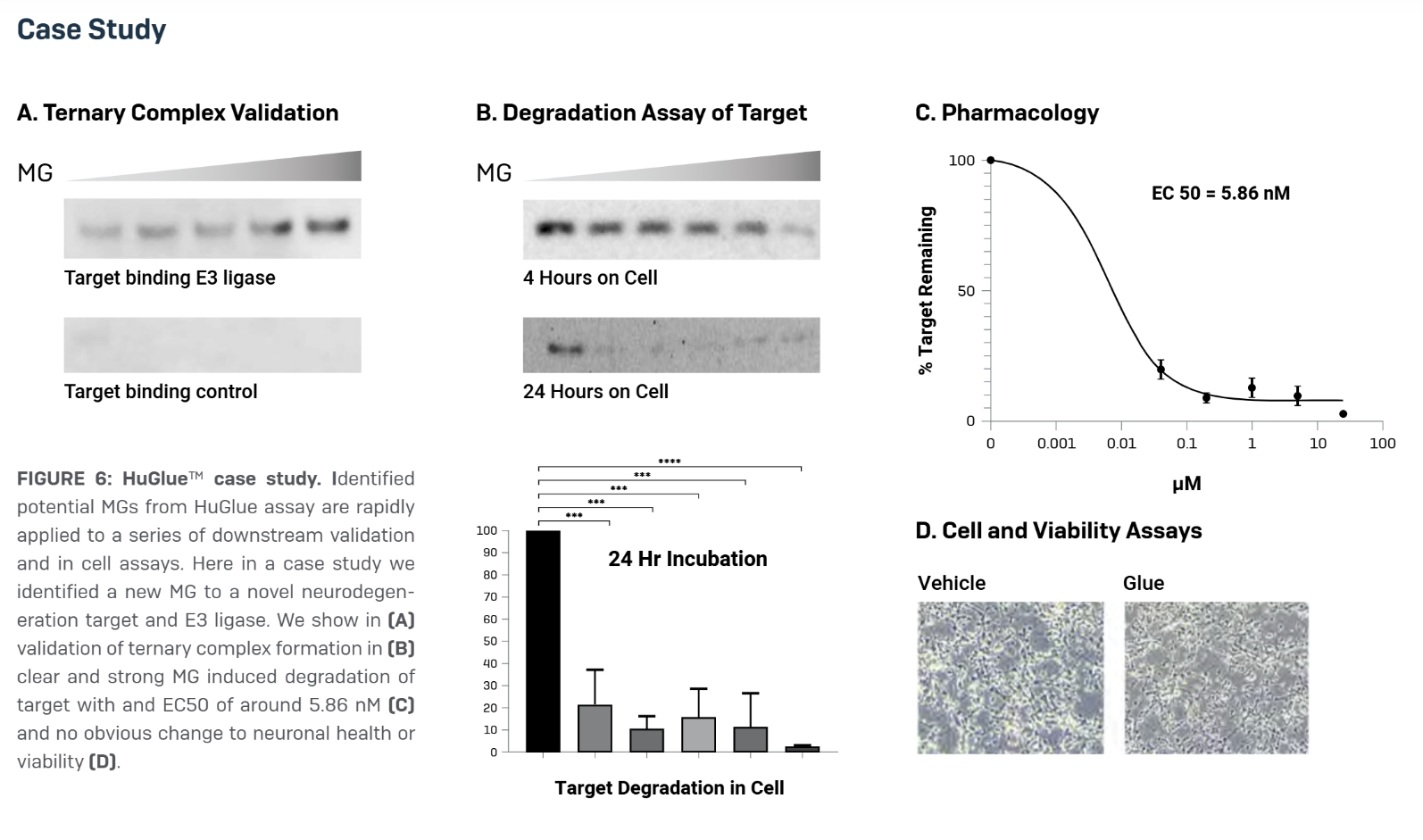
Use Case: Identification of a new molecular glue to a novel neurodegeneration target

Read how the HuGlue Technology Access Programme  identified a new molecular glue to a novel neurodegeneration target and E3 ligase with:

  • Validated ternary complex formation

  • Clear and strong MG-induced degradation with EC50 of ~5.86nM

  • No  obvious impact on neuronal health or viability
Read the Application Note

Why researchers choose the HuGlue Technology Access Programme

HuGlue Technology Access Programs support diverse molecular glue (MG) program goals; adding expert resource to your team. For example:

De novo glues screening:

Re-wire PPIs, identify novel molecular glues, validate in cells, select hits for program advancement

Portfolio expansion:

Validate existing molecular glues, extensive SAR development, confirm mechanisms of actions

AI validation:

Mechanism-of-action confirmation for computationally derived targets

Novel target discovery:

Potential MGs rapidly enter downstream validation in cell-based assays

CDI Labs

Your partner in proteome-wide binding characterisation

CDI Labs is a specialized CRO and lab services company powered by advanced synthetic biology platforms. We have created the largest collection of proteomes and built a team with deep bench experience in proteomics. We partner with research and drug development teams to:

  • Decipher molecular interactions across entire proteomes
  • Characterize binding, specificity, and immune responses
  • Strengthen scientific and commercial outcomes through collaboration and consultation

Ready to add rational design and built in cellular validation to your PROTAC or molecular glue pipelines?

Partner with CDI Labs to accelerate your molecular glue discovery, identify validated ternary complexes and strengthen your drug development pipelines.